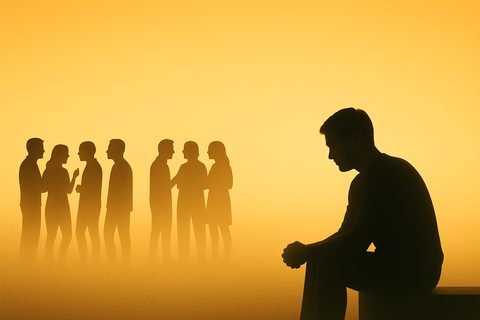
Spectator's War, Why We Love Conflict We'll Never Fight

This is not about whether any particular war is right or wrong. It is about the psychology of those of us watching from the sidelines, the comfortable distance from which we consume conflict like entertainment while real people bleed. Why we crave the drama, and what it costs the people who actually pay for it.
Have you noticed how passionate people get about wars they will never fight? How eager they are to debate military strategy from their living rooms, to argue about what should be done while sipping coffee in their pajamas?
There is something disturbing about our relationship with war, and it reveals something ugly about us that most of us would rather not accept. Let me walk you through it.
War as meaning and entertainment
Here is an uncomfortable truth. There are people actively looking for war. Not because they want to fight. They want the drama, the story, the sense of purpose that conflict provides from a safe distance.
War gives meaning to lives that feel meaningless. It provides clear good guys and bad guys in a world that is usually complex. It offers a grand story in which people can cast themselves as heroes without ever facing a single bullet.
Think about it. When was the last time you heard someone at a dinner arguing for peaceful resolution with the same intensity they bring to debating military intervention? The energy around conflict is always higher, always more engaged. We are drawn to the fight.
The distance that lets us consume it
We have created a mental distance that lets us enjoy war without facing its true cost. We watch drone footage like it is a video game. We read casualty numbers like sports statistics. We consume conflict through a sanitized lens that shows us just enough to feel informed but never enough to truly understand the horror.
There is a thought experiment once proposed to a US President. Put the nuclear launch codes in a capsule implanted next to a volunteer’s heart. To launch, the President would have to personally kill that one human being with a knife to reach the codes. The point was not to make nuclear war impossible. It was to force the person deciding to confront the reality of death directly, to remove the mental distance that makes mass killing an abstract idea.
So why was that suggestion never taken seriously? Because we do not actually want to confront what war is. We want the sanitized version, the one where we debate strategy and ethics without ever seeing a child’s body torn apart by a bomb. We want the movie version, not the reality.
We would rather be wrong together
Our brains are wired to get along with the group. The reward of being accepted, of belonging, often outweighs our genuine desire for truth. So we adopt the group’s position on a conflict, whatever it is, because it feels good to belong.
We would rather be wrong together than be right alone.
Watch how this plays out. Your social circle leans a certain way on a conflict, and suddenly you are defending that position, not because you researched it or lived it, but because that is what your friends and family believe. You share the articles that confirm what your group already thinks. You pick up the same language, the same talking points, the same emotional triggers.
Taking credit for a fight you never joined
And if your group supports the war, you get to take credit for a win you had no part in. You associate yourself with strength, with standing up to aggression, with righteousness, all without risking anything yourself.
It is like being a sports fan whose team wins. You get to say we won, even though you never set foot on the field. The difference is that here the field is real, and people die on it.
The human cost we look away from
What we are really avoiding is the actual cost. The soldiers who come back broken. The families torn apart. The children who lose their parents. The veterans who cannot rejoin a society that has no idea what they have seen and done.
We care about these people from a distance. But do we care about their real experience, or just the story we tell ourselves about their sacrifice? We focus on the hero’s journey, the noble sacrifice, the fight for freedom, rather than the PTSD, the suicide rates, the wounds that never fully heal. We want the clean story, not the messy truth.
This is why most of us prefer not to know the full extent of what soldiers actually go through. It is not just the danger. It is the moral injury, the things they are ordered to do that violate their own sense of right and wrong. It is easier to support a war when you do not have to picture the nineteen year old told to shoot first and ask questions later.
And we do the same with civilians. We turn them into numbers, statistics, collateral damage. We do not want to think about the family dinner interrupted by an explosion, the wedding that became a slaughter, the children who now live in constant fear. It is too real to absorb while keeping our comfortable distance.
War as emotional regulation
So what is really going on? We are using war as a form of emotional regulation. It gives us a place to put our fear, our anger, our sense of powerlessness. It hands us clear enemies and simple solutions in a world that offers neither. It lets us feel righteous, protective, and strong, all from the safety of our homes.
The media understands this perfectly. It feeds us just enough reality to feel authentic and filters out enough horror to keep us watching. Because if they showed us the full truth, the faces of the dying, the screams of the wounded, the exhausted soldiers who have seen too much, we would have to confront something in ourselves we are not ready to face.
We want the drama without the trauma. We want the meaning without the mortality. We want to be part of something larger than ourselves without actually risking anything of ourselves.
At least have the humility
Here is my real question. What does it say about us that we can casually debate life and death decisions over lunch, weighing military intervention like we are choosing a restaurant?
I am not saying you should always support military action, or always oppose it. I am saying that if you are going to hold strong opinions about war, be honest about what war actually is. Real human beings, not numbers, not statistics, but individual people with families and dreams and fears just like you and me, will suffer and die based on those opinions.
So before you get too comfortable on the couch, ask yourself. Am I supporting this because it is truly necessary, or because it makes me feel better about my own life? Am I passionate about this because it is right, or because it gives me something to feel passionate about in an otherwise ordinary day?
Most of us will never know what real war is. Most of us will never make a life and death decision or carry the weight of taking a life. So the least we can do is have some humility about what we do not know. The least we can do is admit that our comfort comes from our distance, and that distance does not make us wise. It makes us ignorant.
War is not a movie. War is not a video game. War is not politics. War is human beings inflicting unspeakable things on other human beings, and everyone involved pays a price. The soldiers, the civilians, the families at home. Everyone loses something.
Get one like it every morning.
Free daily Stoic wisdom — one minute, real practice.